
Timex Just Dropped a $249 Moonwatch — And It’s Closer to Omega Than Anyone Expected


There’s a reason the Omega Speedmaster Moonwatch still dominates every conversation about space watches. It’s not just history; it’s legacy, credibility, and a connection to one of humanity’s greatest achievements.
Now here’s the twist no one saw coming. Timex has just released a NASA-inspired watch that borrows just enough of that legendary DNA to turn heads, but at a price that makes it impossible to ignore.
At $249, the new Q Timex NASA Moonwatch isn’t trying to compete with luxury icons. It’s doing something arguably smarter: giving everyday buyers a piece of that space-age narrative, without the five-figure commitment.
Instead of competing directly, Timex is doing something smarter, borrowing the emotional gravity of space exploration and translating it into a design that feels familiar, nostalgic, and surprisingly detailed at a fraction of the price.
Inspired by Apollo 17 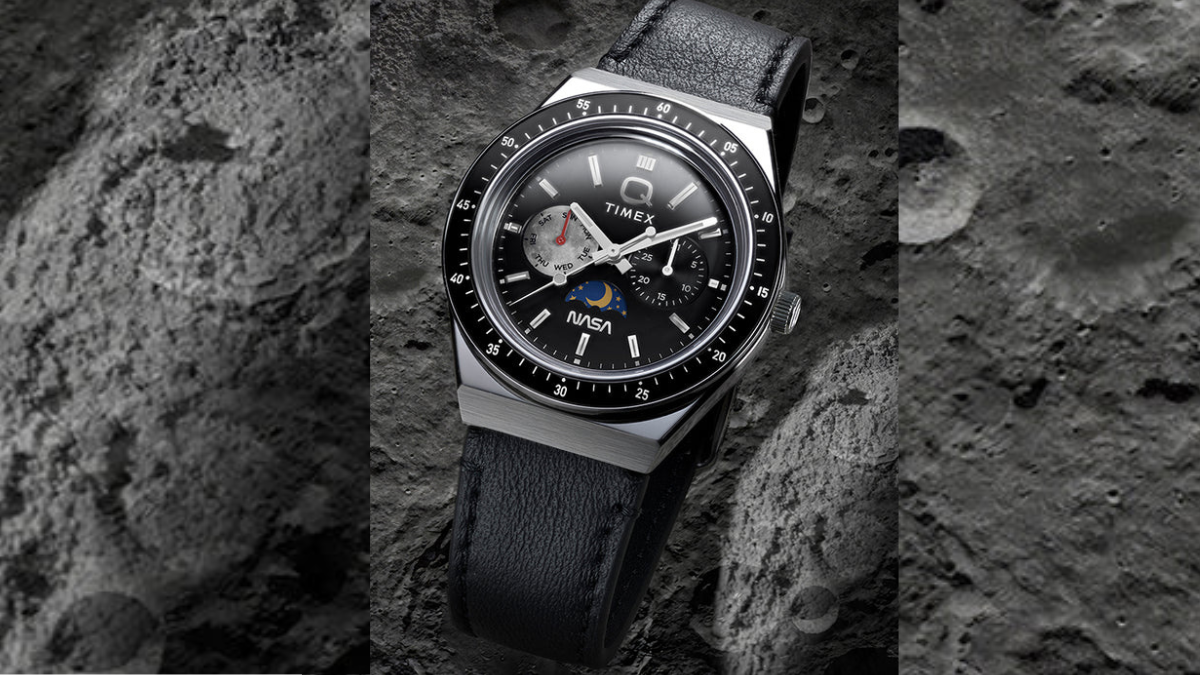
This release draws directly from the Apollo 17 mission, the last time humans walked on the Moon. While earlier missions made history, Apollo 17 carries a different kind of emotional weight. It marked the end of an era, a final footprint before decades of silence. That sense of nostalgia is embedded in the watch in ways that go far beyond branding.
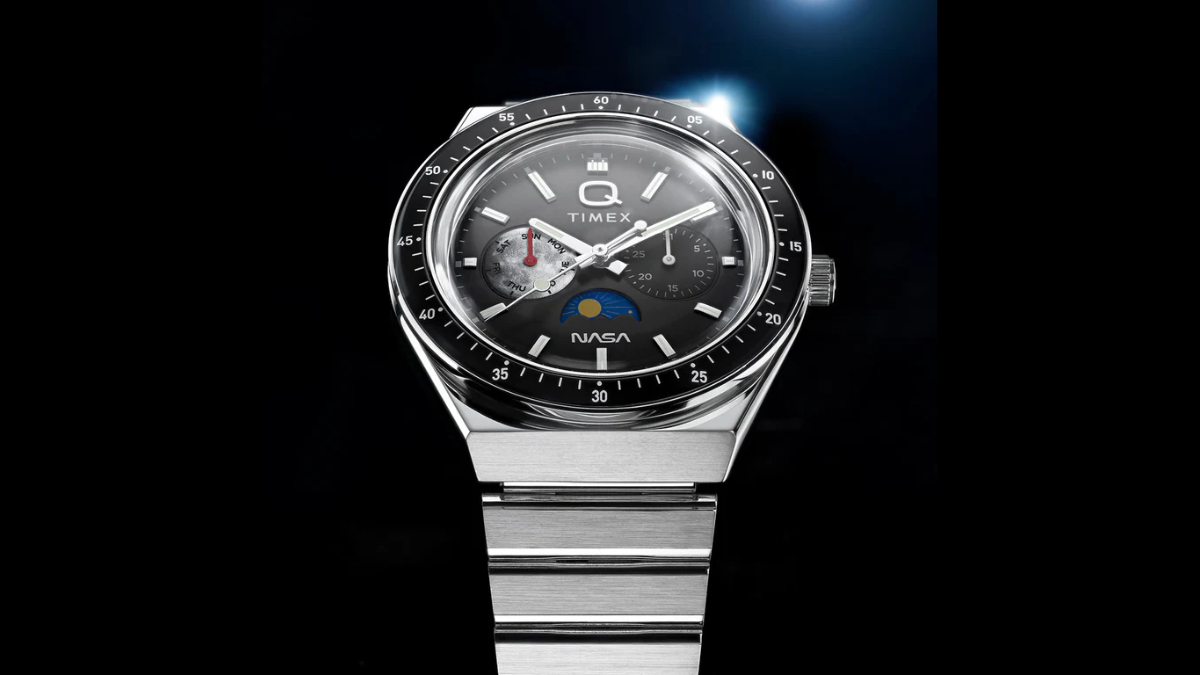
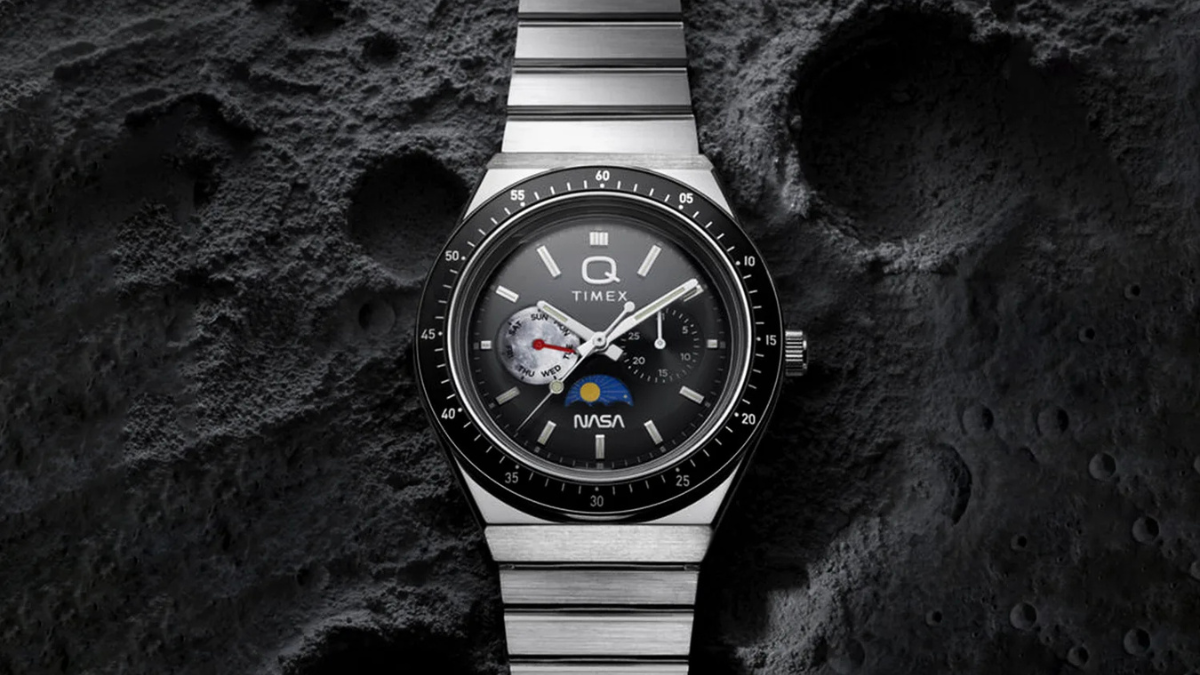
At first glance, the design feels familiar. A black dial. Triple sub-dials. A sporty steel case. The resemblance to the Speedmaster is undeniable, but look closer, and the story changes. This isn’t a chronograph.
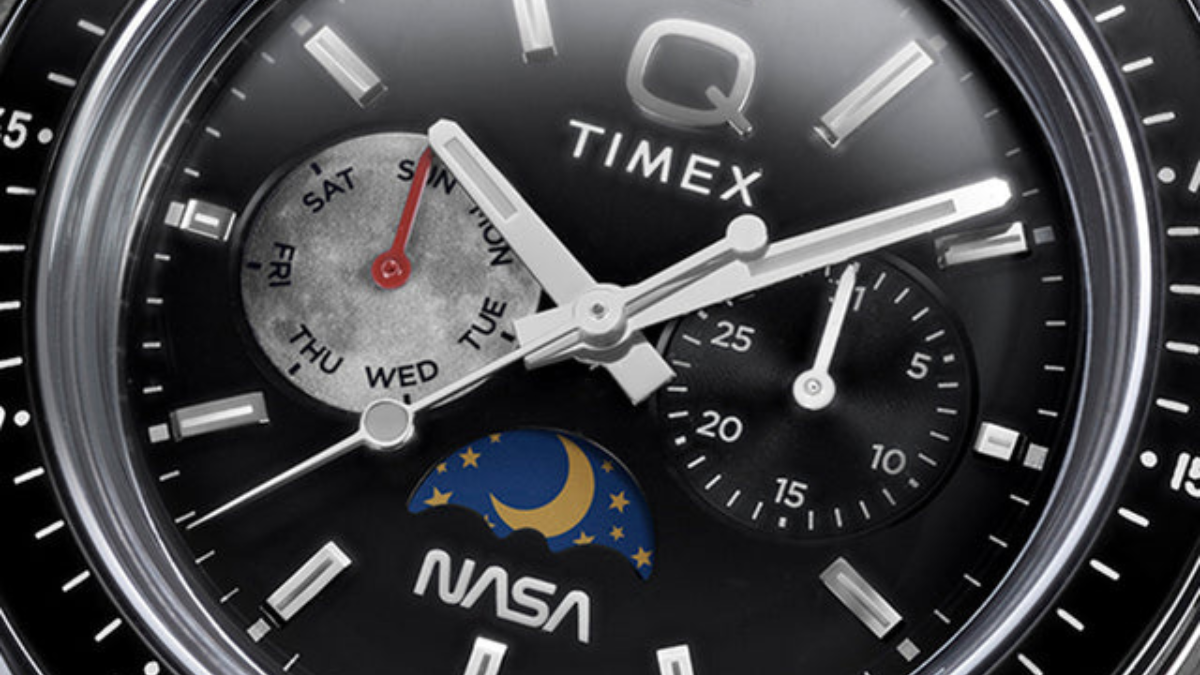
Instead, Timex reimagines the layout with a multifunction quartz movement. The three sub-dials don’t measure elapsed time; they track your daily life. One shows the date, another displays the day of the week, and the most visually striking complication combines a sun-and-moon indicator with subtle NASA branding.
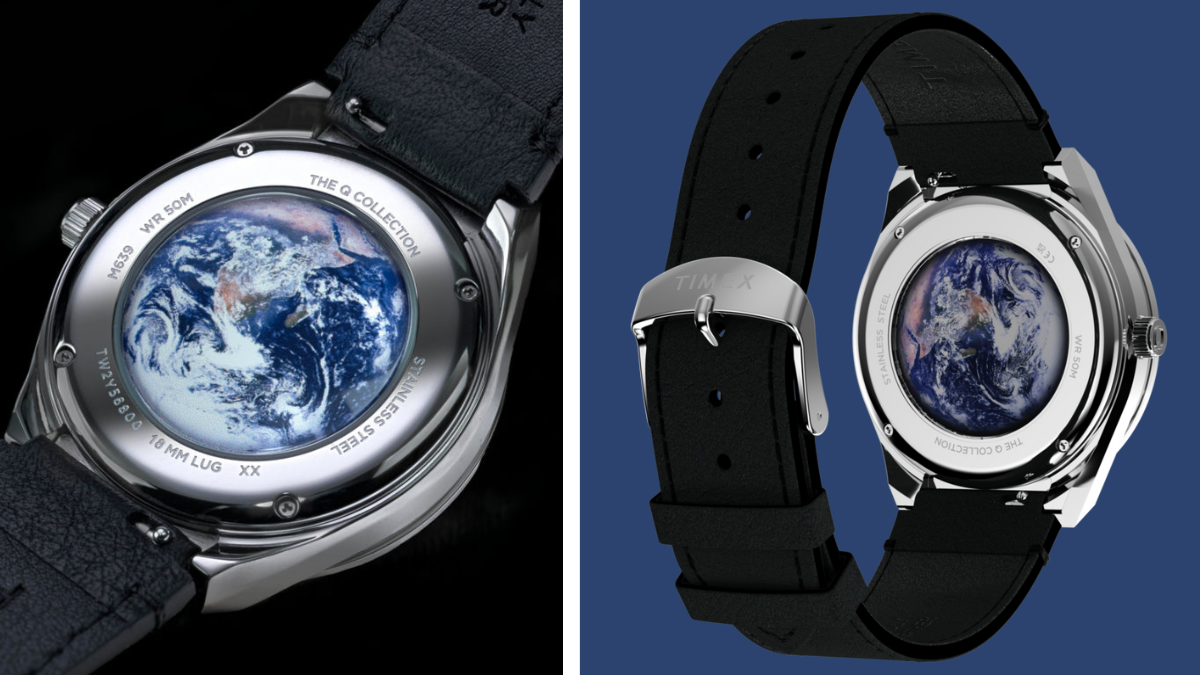
It’s less about precision timing and more about storytelling. Flip the watch over, and you’ll find a full-colour caseback featuring the iconic “Blue Marble” photograph, Earth captured from space, glowing against the void. It’s not just decorative; it’s emotional. It connects the wearer to a moment most brands only reference superficially.
Luminous Moon Detail
The standout detail, however, is something you won’t fully appreciate until the lights go down. The moonphase-style day indicator isn’t just decorative, it’s fully luminescent. Timex has treated it with the same luminous material used on the hands and hour markers, allowing the moon graphic to glow in the dark.
It’s a small feature. But it changes the entire emotional experience of the watch. Because suddenly, you’re not just checking the time, you’re interacting with a miniature tribute to space itself.
Flip the watch over, and the narrative deepens. The caseback features a full-colour rendering of the iconic “Blue Marble” photograph, one of the most famous images ever captured by astronauts. Taken during Apollo 17’s journey back to Earth, it remains a symbol of perspective, fragility, and human achievement.
At this price point, details like this aren’t expected. That’s exactly why they matter.
The watch sticks closely to the brand’s Q Timex DNA, which means vintage inspiration is baked into every element.
You’re getting:
-
A 40mm stainless steel case
-
A domed acrylic crystal that adds distortion and warmth
-
Hooded lugs with a retro integrated-style bracelet
-
A clean, balanced dial layout that doesn’t feel cluttered
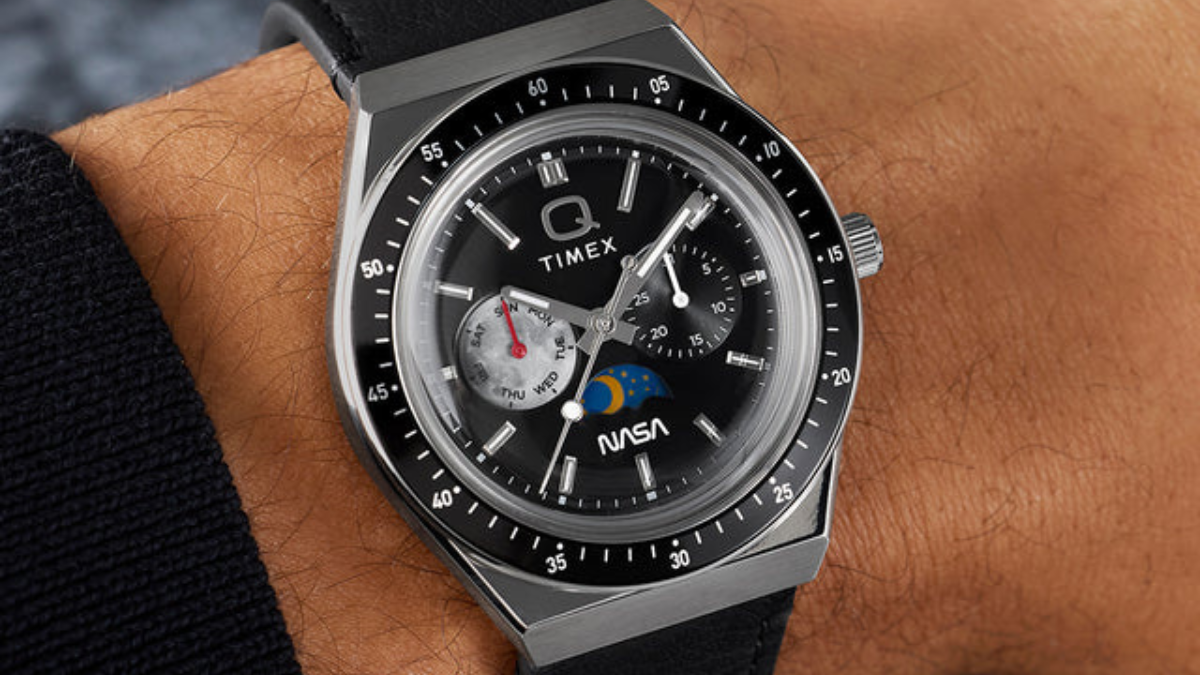
The 40mm stainless steel case hits a comfortable middle ground, large enough to feel modern, but compact enough to wear daily. At 13.5mm thick, it carries a slightly vintage profile, enhanced by a domed acrylic crystal that echoes the aesthetic of classic space watches.
Water resistance is rated at 50 meters, making it suitable for everyday wear, though it’s clearly not built for serious aquatic use.
The bracelet follows the familiar Q Timex design language, with a flat-link style that leans heavily into retro inspiration. Alternatively, a leather strap version offers a slightly more understated look.
Then there’s the bezel, one of the more curious elements of the watch. Visually, it resembles a tachymeter scale, a signature feature of the Speedmaster. But here, it’s purely ornamental. Instead of measuring speed, it features 60-minute markings and remains fixed in place.
For some, that might feel like a missed opportunity. For others, it reinforces what this watch really is: not a tool, but a tribute
Inside, you won’t find a mechanical movement, and that’s intentional. The Q Timex NASA runs on a quartz calendar movement, prioritizing:
-
Accuracy
-
Low maintenance
-
Affordability
In a market where entry-level mechanical watches often struggle with consistency, this decision makes the watch more accessible to a broader audience. It’s not trying to impress horology purists. It’s trying to win over smart buyers.
Pricing
At $249 on a bracelet and $229 on leather, the watch sits in a category that’s seeing increasing competition. But very few pieces in this range offer this level of thematic depth combined with recognizable design cues.
It’s also impossible to ignore the broader trend. Space-themed watches are gaining momentum again. With renewed interest in lunar missions and private space exploration, the cultural relevance of “Moonwatch” designs is rising once more.
That creates an interesting dynamic. Affordable releases like this often serve as entry points, but they also tend to disappear quickly when demand spikes, especially when they tie into iconic narratives like NASA and Apollo missions.
From a collector’s perspective, this puts the watch in a unique position. It’s not rare. It’s not mechanically complex. And it doesn’t carry traditional investment appeal.
But it does have something else: timing. It arrives at a moment when space history is becoming culturally relevant again. When nostalgia for analogue exploration meets modern accessibility. And when brands are starting to realise that storytelling can be just as powerful as specifications.
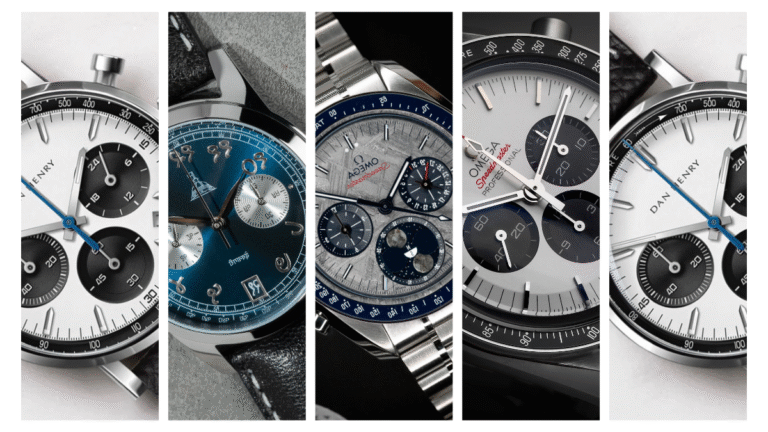
It’s impossible not to think about the Omega x Swatch MoonSwatch when looking at this release. That watch proved one thing: demand for space-inspired, Speedmaster-adjacent designs is massive.
But where the MoonSwatch leaned into hype, scarcity, and long queues, Timex is taking a quieter approach. No chaos. No artificial shortages.
Just a well-designed watch with real storytelling, and immediate availability. Ironically, that might make it more collectable over time.
Will This Q Timex NASA Moonwatch Become a Future Collector Piece? That’s the question smart buyers are already asking. And the answer isn’t as obvious as you might think.
Here’s what works in its favour:
-
Strong NASA and Apollo 17 narrative
-
Unique dial execution (especially the luminous moon)
-
Affordable entry point
-
Growing interest in vintage-inspired Q Timex models
What could drive future demand:
-
Limited production runs (if supply tightens)
-
Increased attention from watch media and collectors
-
Secondary market scarcity
At under $250, the risk is minimal.
Final Thoughts
The Q Timex NASA Moonwatch isn’t trying to dethrone legends. It doesn’t need to.
What it does instead is far more interesting; it democratises a design language and emotional connection that has historically been locked behind luxury price tags.
It gives more people access to the feeling of wearing something inspired by humanity’s greatest adventure. And in doing so, it positions itself as one of the smartest, most culturally aware releases of the year.