Why Are Richard Mille Watches So Expensive? The Shocking Truth Revealed

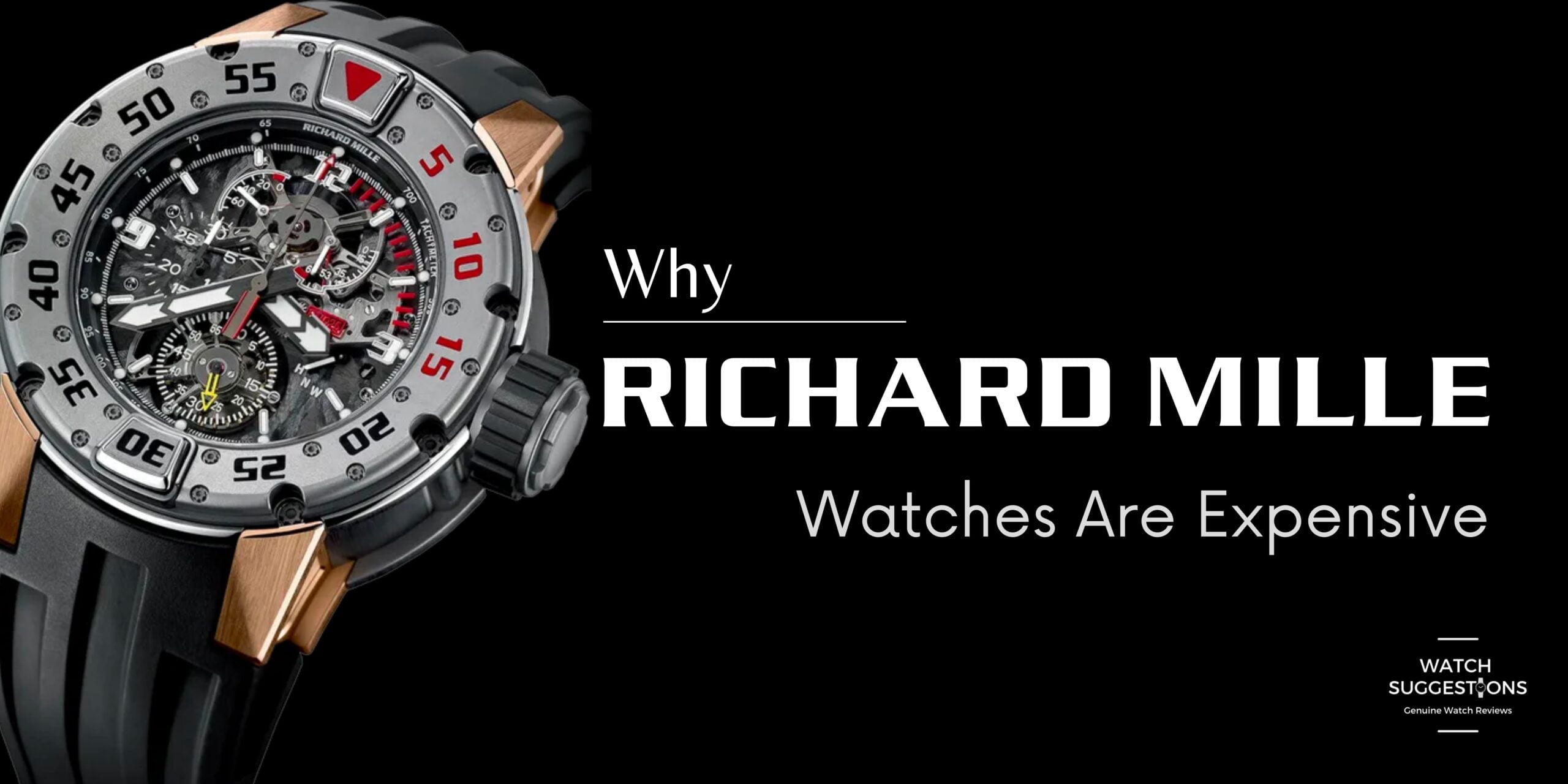
Richard Mille has only existed since 2001, yet it has become the most expensive watch brand in the world. A brand-new entry-level model starts at around $80,000. Their tourbillons can exceed $2 million. Most people will only ever see one on a celebrity’s wrist or in a YouTube video. So what exactly are you paying for? Here are five specific reasons why Richard Mille watches cost what they cost.
The cost to join the Richard Mille club is approximately $80,000. That is for their “cheapest” model, a brand-new RM 005. You might be able to get it for 20% less than the retail price if you buy it used. The watches keep going up and up from there. Richard Mille watches cost anywhere from $80,000 to more than $2 million.
Tourbillon models typically cost between $500,000 and $800,000, despite being among their most in-demand pieces. The entry price of $80,000 already places Richard Mille above Patek Philippe, Rolex, and Audemars Piguet for most models.
So, why are Richard Mille’s timepieces so costly? And is the cost reasonable? Before getting into the five reasons, here is a brief background on the brand itself.
History of Richard Mille

In the 1970s, Richard Mille began his career at the French watch company Finhor. When Matra acquired Finhor in 1981, Mille rose through the ranks and eventually led the entire watchmaking division.
Mille left Matra, which had been bought out by Seiko by that point, after about a decade, and took over as the head of a new watchmaking venture for jewellery company Mauboussin, which was trying to break into the luxury watch market. At the end of the 1990s, Mille decided to start his own brand, what we now know as Richard Mille.
He launched the business in partnership with Audemars Piguet, which remains a shareholder today. The founding idea was simple: bring watchmaking into the modern era using materials and engineering from motorsport and aerospace.
The RM001, Richard Mille’s first watch, was released within two years (around 2001). The watch industry had never seen anything like it. It was a tourbillon watch.
High-profile ambassador partnerships with Rafael Nadal, Felipe Massa, and Pharrell Williams followed, cementing the brand’s reputation in sports, entertainment, and luxury simultaneously.
With that context in mind, here are the five specific reasons behind the price.
Watchmaking
A Richard Mille is instantly recognizable, it looks like a cross between a futuristic timepiece and a Formula 1 race car. That’s intentional. Motorsport engineering is the brand’s primary design inspiration, and every element of the case reflects that.
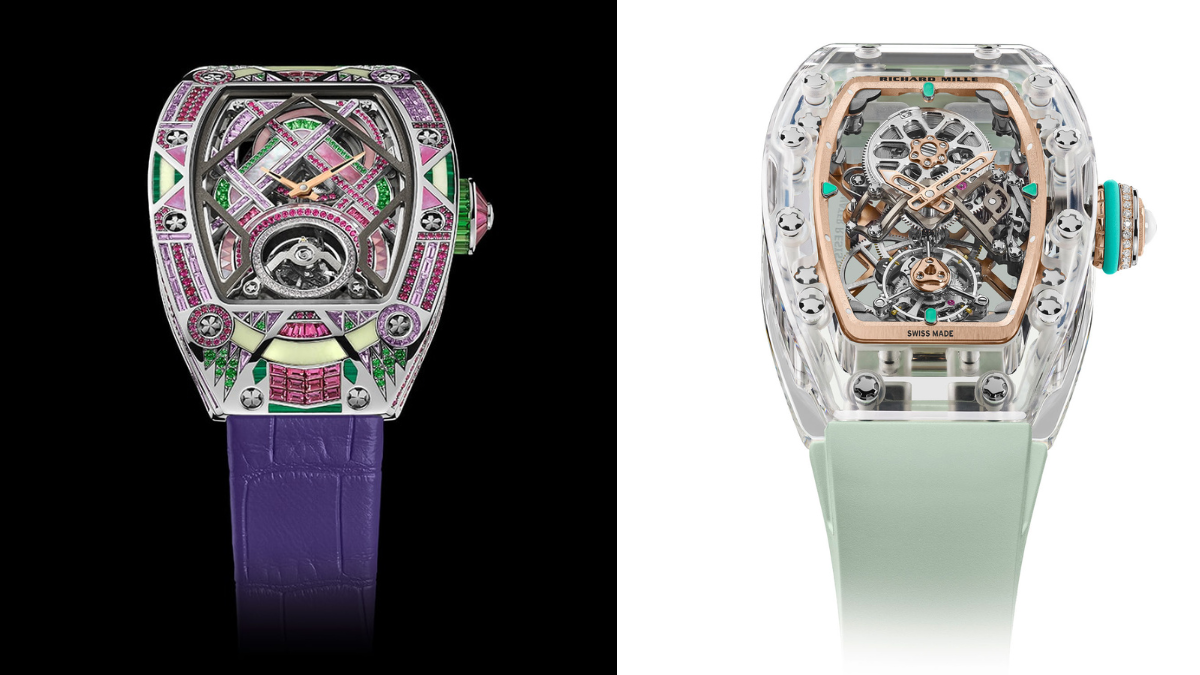
The tonneau-shaped case is very famous. The signature tonneau-shaped sandwich case has three curved decks — a middle section flanked by front and back bezels. Because there are no flat surfaces, machining is extraordinarily difficult. The curved surfaces must align within a hundredth of a millimetre to prevent moisture and dust from entering
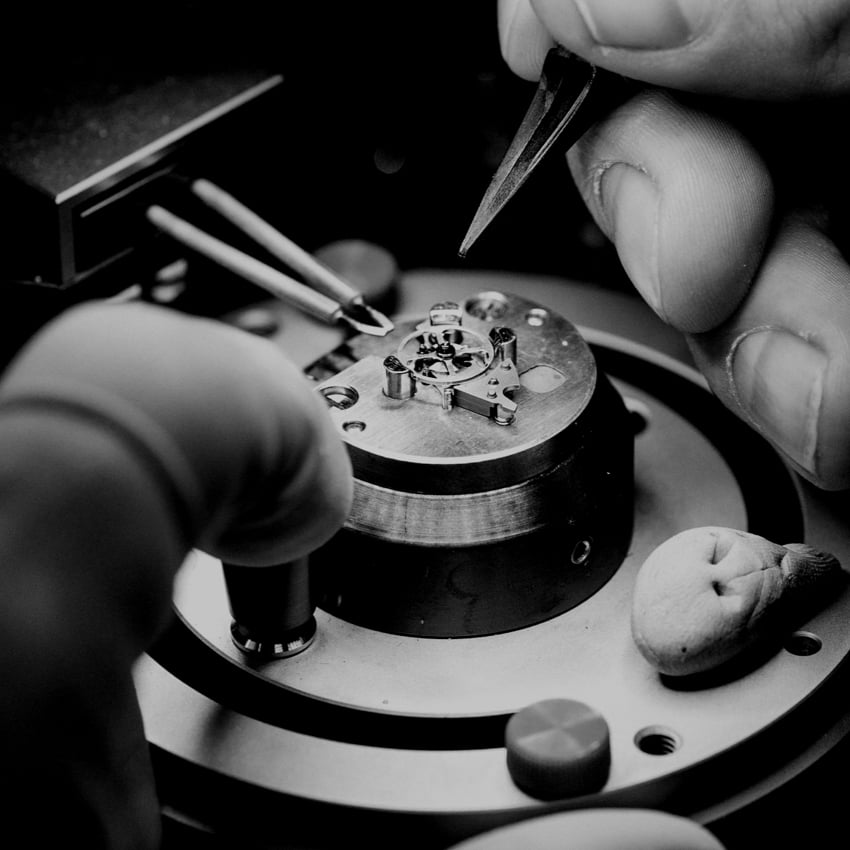
Every decision, from case geometry to strap attachment, is made with both aesthetics and ergonomics in mind. All finishing is done by hand.
Most Richard Mille dials are skeletonized, meaning the dial is removed entirely so you can see straight through to the movement. Multiple layers of sapphire crystal keep the movement protected while maintaining full visibility. Watchmaking at this level is extraordinarily labour-intensive. It requires precision engineering that most factories cannot achieve.
Innovative Materials
The materials Richard Mille uses in their cases were originally developed for Formula One cars, racing yachts, and aerospace applications. Adapting these materials for watchmaking required years of research and millions of Swiss francs in development costs, and those costs are reflected directly in the price. The compositions of these metals and materials are novel to watchmaking. This isn’t marketing language; the materials serve a genuine engineering purpose.
It will become clear when you try on a Richard Mille. Despite their size, Richard Mille watches are very light. They only average 40 grams in weight. It’s like having a credit card on your wrist! Additionally, these materials add tremendous toughness and endurance to the mix. The construction as a whole is very sturdy, the feel is light, and the patina is stunning.
When you combine these materials with the complex curved case architecture discussed above, the manufacturing challenge becomes even clearer. The list of materials goes on and on. The silicon nitride, gold fused with carbon and quartz, carbon nanotubes hardened with ceramic, etc.
The manufacturing process for Carbon TPT creates random layering patterns, meaning no two cases look exactly alike. Every Richard Mille is genuinely unique.
Complicated Movements
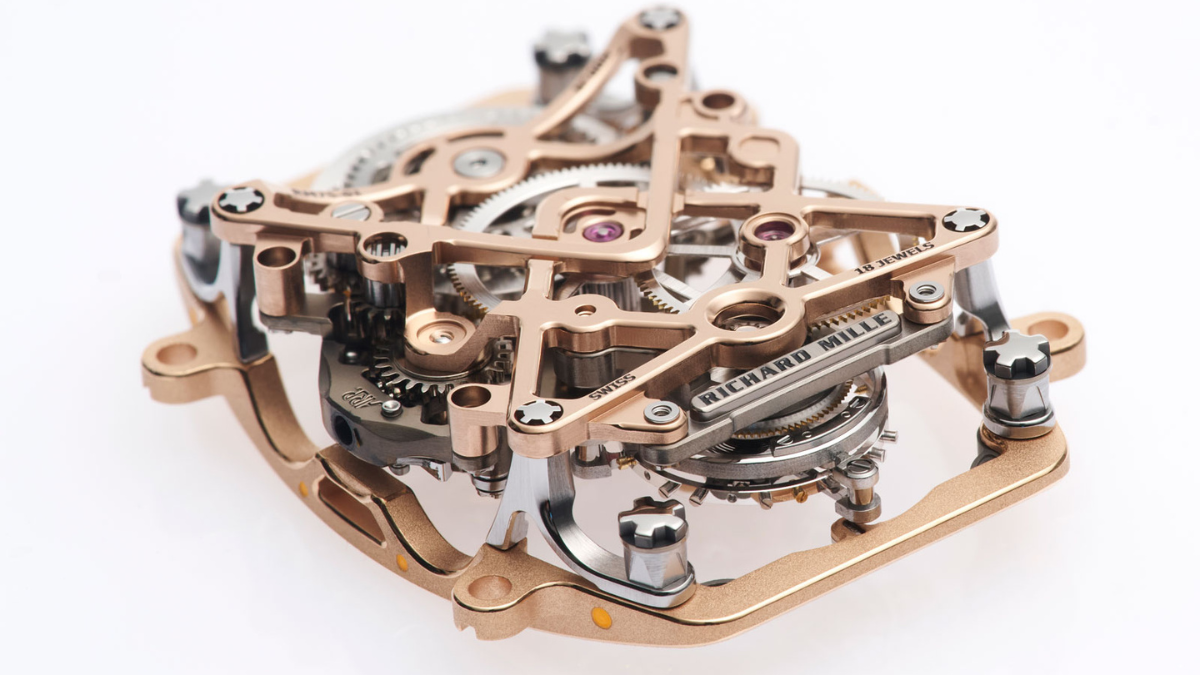
The same philosophy applied to the case extends to the movement. Most Richard Mille movement components are made from a titanium alloy, roughly 90% grade 5 titanium, 6% aluminium, and 4% vanadium — materials normally found in surgical implants and aircraft components, not watch movements.
Baseplates and bridges are treated with PVD (Physical Vapour Deposition) or Titalyt coatings for durability. Developing these applications for watch-scale components took Richard Mille’s engineering team years to perfect.
Richard Mille is also known for its tourbillons, a rotating cage mechanism that counteracts the effect of gravity on timekeeping accuracy. Their versions are entirely redesigned using high-tech materials, making them among the most technically advanced tourbillons in production watchmaking.
The result is a movement built to withstand extreme physical stress — Rafael Nadal wore his RM 027 while winning at Roland Garros, and Felipe Massa wore his during Formula 1 races. These are not watches designed to sit in a safe.
Scarcity
Manufacturing a Richard Mille takes an enormous amount of time. The majority of the work is done by hand.
But that isn’t the only reason why there aren’t many Richard Mille watches. It comes down to exclusivity as well. It loses some of its mystique if you produce a large number of watches every year.
As a result, Richard Mille only produces fewer than 5,000 watches per year. For such a young brand, that is not exactly a small number, but it does keep things very exclusive.
Every year, there is a lot more demand than there is supply, which keeps people wanting more. This effect is worsened by the fact that many models are produced in limited quantities as well.
The strength of this brand’s value can be seen in the high auction and secondary market prices.
Altogether, scarcity is a very effective marketing strategy. This brings us to our final explanation for the high price of Richard Mille watches.
Marketing

Only the richest people wear Richard Mille watches on their wrists. In the watch industry, it has evolved into the pinnacle of wealth expression. For those who wear Richard Mille watches, they coined the term “Billionaire’s Handshake.”
Richard Mille’s marketing may be as impressive as the engineering. The ambassador strategy — placing watches on the wrists of Nadal, Massa, and Pharrell — created aspirational desire across sports, motorsport, and entertainment simultaneously. They have successfully created a strong sense of exclusivity. If you own a Richard Mille, you are aware that only you can afford one.
Alongside Patek Philippe, Richard Mille has become one of the two most recognizable status symbols in the watch industry — but Richard Mille is louder, bolder, and instantly identifiable even to people who know nothing about watches.
Even more so because people are aware that you paid a lot of money for a Richard Mille. Also, only the wealthiest celebrities wear them. Richard Mille’s name alone carries a significant premium. The brand has achieved something rare — instant recognition across audiences who would never recognise a Patek Philippe reference number.
It is a difficult business model to execute, and Richard Mille has executed it better than almost any brand in history. Their slogan, ‘A racing machine on the wrist,’ captures the entire philosophy in five words.
Where Does the Money Actually Go?
People often ask me to break down where the $80,000 minimum price actually goes. Here’s my rough understanding based on everything I’ve read and researched about the brand:
The materials alone: grade 5 titanium, carbon TPT, NTPT carbon, cost more per gram than gold in some cases because of the R&D required to work with them at watch scale.
The movement finishing is done by hand. On a tourbillon model, a single watchmaker may spend weeks on one movement.
Limited production means no economies of scale. When you make fewer than 5,000 watches a year across dozens of models, you cannot spread costs the way Rolex can across 1,000,000 units.
And finally, brand premium. A significant portion of the price is simply what the market will bear, which for a watch worn by Rafael Nadal on a tennis court is apparently quite a lot.
Conclusion
Richard Mille watches are expensive because almost nothing about making them is conventional. The materials come from aerospace and motorsport. The movements are hand-finished to a standard that most brands reserve for pieces costing a tenth of the price. And the brand deliberately limits supply to protect exclusivity.
Whether the price is justified depends entirely on what you value. As a pure engineering object, almost nothing else competes at any price. As a status symbol, nothing else signals wealth quite as loudly. Whether either of those things matters to you is a personal question only you can answer.