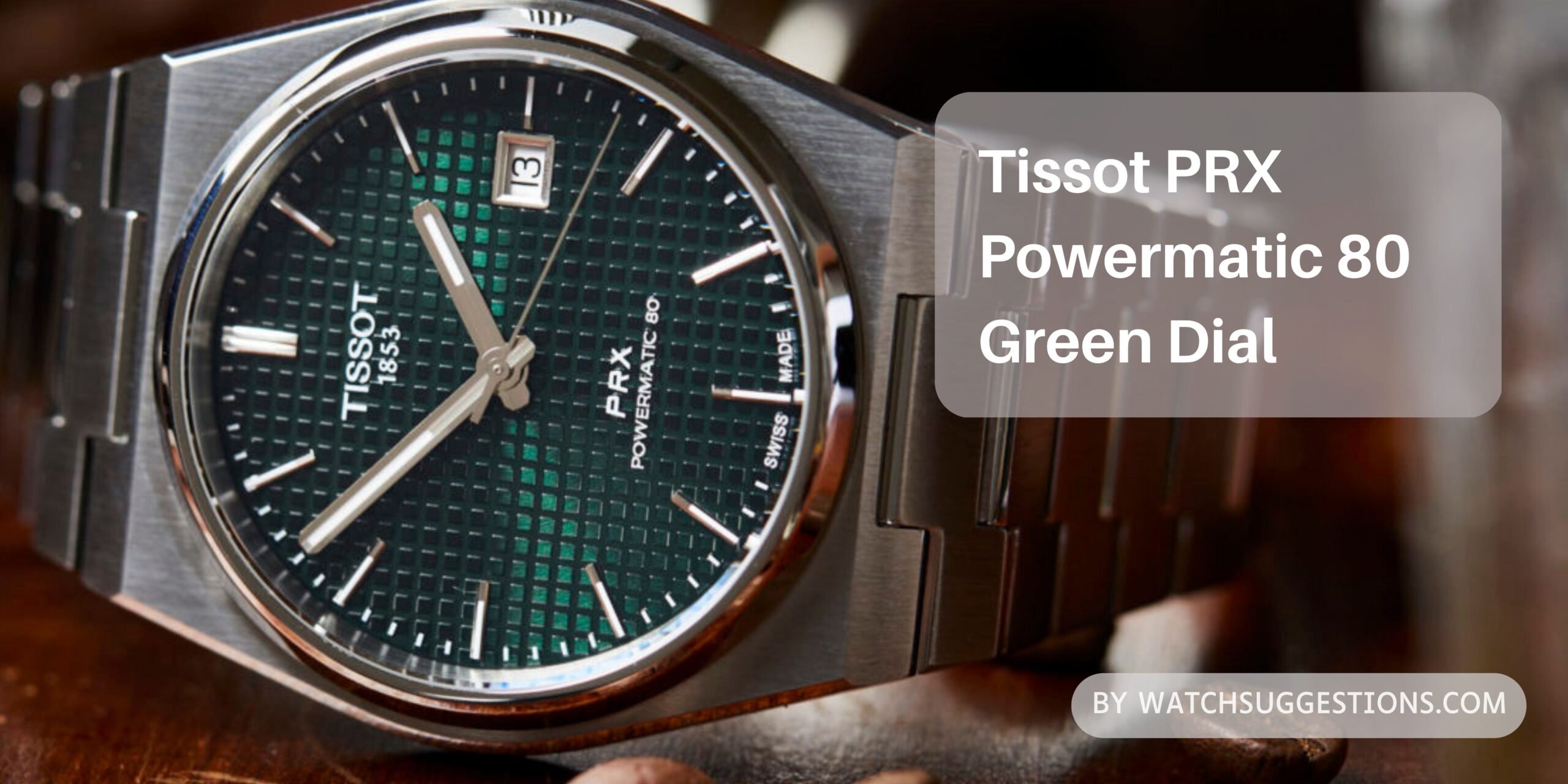
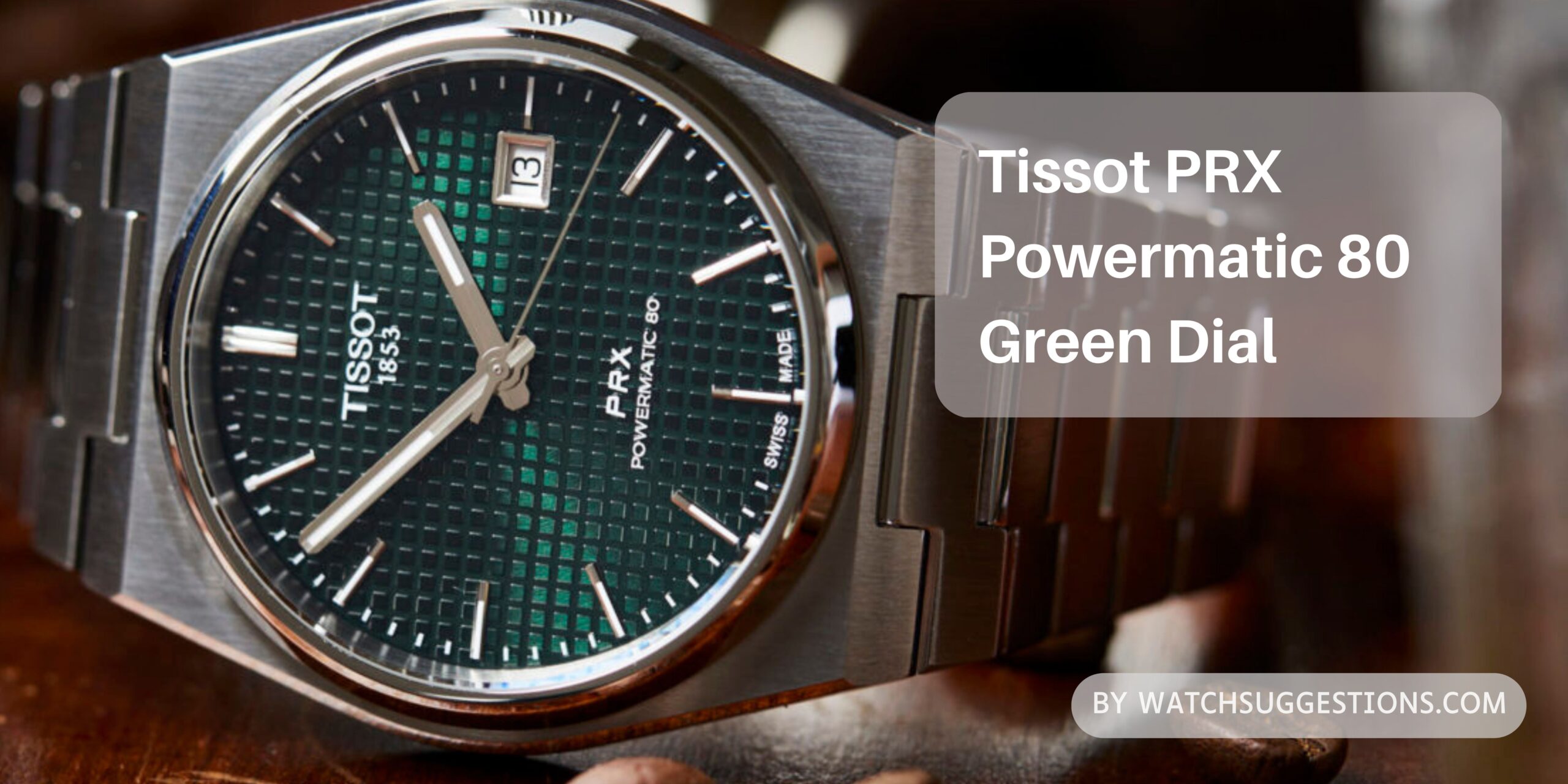
Green Dial Tissot PRX Powermatic 80 Review: The $850 Watch Everyone Wants

The Green Dial Tissot PRX Powermatic 80 launched in 2021 and immediately became one of the most discussed watches under $850. The reason is straightforward: it offers an integrated bracelet design, an automatic movement with 80-hour power reserve, and a sapphire crystal at a price point where most competitors still use mineral glass and battery-powered movements. This review covers what the watch actually delivers, where it cuts corners, and whether the green dial specifically is worth buying over the black or blue versions.
What does PRX stand for?
PRX stands for Precise, Robust, and X, where X represented the unknown or experimental in Tissot’s 1970s naming system. The 100-meter water resistance is a specification of the watch itself, not what the X stands for. Tissot revived the PRX name in 2021 specifically to reconnect the modern lineup with the original 1978 Seastar PRX.
Appearance
Tissot launched the green dial version in 2021 after the black and blue models had already proven the PRX concept worked commercially. Green was a deliberate choice; it sits in the same family as the Rolex Submariner green and the Omega Seamaster green, but at one-tenth of the price. On the PRX specifically, the green works better than on most watches because the tapisserie dial pattern gives the colour depth and texture that a flat dial cannot.
The Green Dial Tissot PRX Powermatic 80 is directly inspired by the 1978 Tissot Seastar PRX — an integrated-bracelet sports watch that predates the Royal Oak by several years and shares the same Gérald Genta-influenced design language. It also offers a straightforward time-and-date display on a classic brushed green dial.
In the context of the 2021 PRX, almost everything that made this watch special has been brought back with modern updates. The barrel-shaped case still has clean lines and a raised polished bezel with a flat crystal. The case is water-resistant to 100 meters. The finishing is predominantly brushed, with polished chamfers on the case sides and bracelet link edges, creating contrast without making the watch look flashy.
For $850, the case finishing is genuinely impressive. Yes, the 40mm diameter is larger than the original 1978 model, but the proportions work well on most wrists in 2026, and the 10.9mm thickness keeps the watch from feeling bulky under a cuff.
The Dial
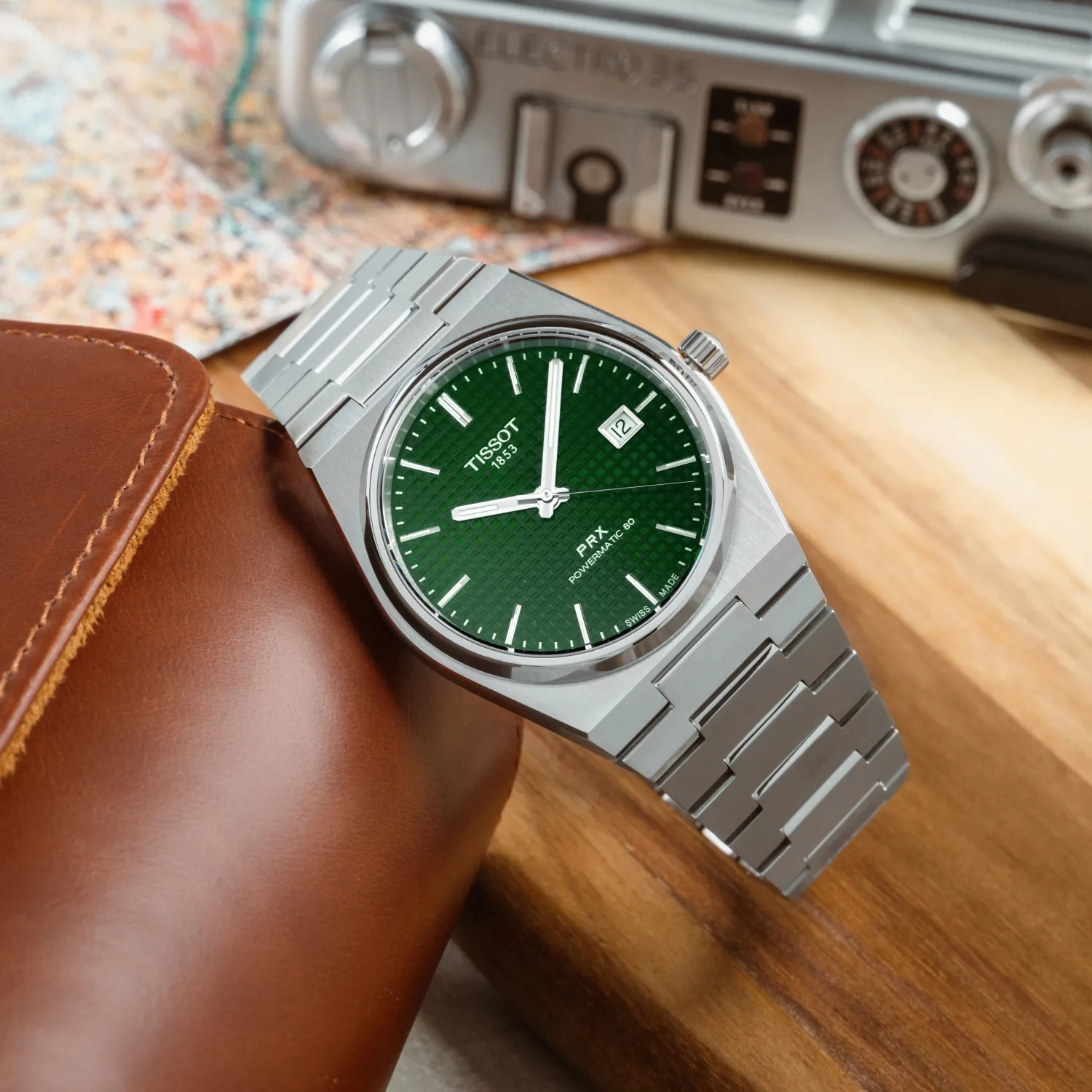
The raised surfaces of the squares with a circular grain pattern in the Clous de Paris finish appear to come from the dark green pool below.
The hour hands, minute hand, applied indices, and date window frame are all finished in silver — the only accent colour on the dial, which keeps the green from feeling overwhelming. The most appreciated detail is the arrangement of the records and date window. Take note of the 3 o’clock index, which cuts the stamped dial pattern in half.
The green dial actually uses three separate finishing techniques: a sunburst radial pattern underneath, a tapisserie embossed grid on top, and a circular grain on the raised squares. Layering three finishes on a dial at this price is unusual and is one of the specific reasons the green dial looks richer in person than it does in product photos. The risk with green dials is that the colour looks cheap under artificial lighting. Tissot avoided this by going darker rather than brighter with the hue.
Case and Bracelet
The killer combination of the case and bracelet is the PRX signature. While an image above provides a clear view of the vertical brushing that runs from the case’s top through angled lugs and onto the bracelet links.
Tissot uses highly polished chamfers on the side of the case, the ends of the links, and the smooth sloping bezel to break up the matte steel and add a little sparkle.
Even though the PRX’s 40mm case is only 10.9mm thick, no PRX review is complete without mentioning the watch’s 51mm wide lug-to-lug width due to its non-articulating first lug.
Most people won’t worry about this because the bracelet moves well. However, people with smaller wrists may notice some gaps below the lugs.
The PRX achieves its 100-meter water resistance through a sealed push-down display case back with gasket protection, not a screw-down mechanism. This is sufficient for swimming and light water activities, but not for serious diving.
Movement
The PRX automatic keeps the venerable Powermatic 80 that powers so many value-oriented Swatch Group products. It lasts for an entire week because it has an 80-hour power reserve. If you choose to wear a beater for weekend activities and wear the PRX from Monday through Friday, the Tissot will work on Monday morning.
Technical Aspects
Case diameter: 40mm
Thickness: 10.9mm
Lug-to-lug: 51mm
Case material: stainless steel
Crystal: sapphire with anti-reflective coating
Case back: display back with movement visible through the glass.
The Green Dial Tissot PRX Powermatic 80 has a water resistance body of 100 meters for you to dive while wearing it. Dark green dial with an embossed waffle “tapisserie” pattern; applied metallic markings; and Super-LumiNova hands.
The self-winding Powermatic 80 movement, specifically the Powermatic 80.111, is housed inside the automatic version of the Tissot PRX. It is based on the Swiss ETA 2824. The Swiss-made Powermatic 80 has 23 jewels.
Power Reserve PRX Powermatic 80

An 80-hour power reserve is enough to keep the watch running for nearly three days, or an entire weekend, when not on the wrist, and nearly doubles the average. 40-hour power reserve on other entry-level to mid-level automatic watches.
The beat rate of the movement is 21,600 BPH. If they had increased the beat rate, the power reserve would have suffered as a result.
The Powermatic 80 has a stainless steel bracelet with polished features that are installed with a triple-folding clasp with push buttons for safety. The Green Dial Tissot PRX Powermatic 80 is currently available from the Tissot online store.
Which Version Should You Buy?
Black dial (T137.407.11.051.00) — the most versatile option. Works with formal and casual outfits equally. If you are buying one PRX and you are unsure, buy this one.
Green dial (T137.407.11.091.00) — the most interesting dial in the lineup. Better than the black in casual settings, slightly less flexible at formal occasions. Best choice if you already own a black or navy dress watch.
Silver dial with rose gold (T137.407.21.031.00) — the dressiest version. Suits formal wear, but the rose gold ages the design quickly. Only buy this if you specifically prefer warm tones.
Steel and 18K gold version — not worth the premium unless you specifically need precious metal on the bracelet. The movement is identical to the $650 models. You are paying mostly for the gold material, not for a better watch.
Real Drawbacks

The 51mm lug-to-lug is the biggest practical problem. On wrists with a circumference of under 17 cm, the lugs will overhang the wrist bone visibly. Check your wrist measurement before ordering, this is not a small-wrist-friendly watch despite the 40mm case diameter.
The Powermatic 80 movement runs at 21,600 BPH, which is slower than most competing movements at this price. At this beat rate, the second hand has a slightly choppy sweep compared to movements running at 28,800 BPH. It is not dramatic, but it is noticeable if you look carefully.
Regulating the movement, adjusting it if it runs fast or slow, requires a specialist watchmaker. The free-sprung balance wheel cannot be adjusted with a simple timing screw. If your watch runs more than 10 seconds per day off, budget for a watchmaker visit rather than attempting self-regulation.
The bracelet clasp is functional but not refined. At $850, the micro-adjustment system works, but the clasp does not have the solid feel you get on a Tudor or Longines bracelet. It is the one area where the price point shows clearly
How It Compares to the Real Alternatives
Most buyers considering the Green Dial Tissot PRX Powermatic 80 are also looking at three other watches in the same price range:
- Seiko Presage SPB167 at $500 — gives you a more traditional dress watch aesthetic and Seiko’s in-house movement, but no integrated bracelet and only 50-meter water resistance.
- Hamilton Jazzmaster Viewmatic at $595 — offers a cleaner, more minimal dial and ETA 2824 movement, but again, no integrated bracelet and a more conservative design.
- Longines HydroConquest at $1350 — steps up in finishing quality and offers a true diver rating at 300 meters, but costs $225 more and has a sportier, bulkier case.
The PRX wins specifically because of the integrated bracelet at this price. No other watch under $900 executes that design as cleanly. If the integrated bracelet matters to you, the PRX is the obvious choice. If it doesn’t matter, the Seiko Presage gives you better movement finishing for less money.
Conclusion
The green dial Tissot PRX Powermatic 80 is the strongest version of this watch. The colour adds depth that the black dial lacks, and it sits between the blue dial’s casual feel and the silver dial’s formality, making it the most versatile option in daily wear.
What you are getting: an integrated bracelet design executed at a level that usually costs three times more, an 80-hour power reserve that genuinely solves the weekend winding problem, and a sapphire crystal that most $850 watches don’t include.
What you are giving up: in-house movement, a case back that shows the movement clearly, and any significant resale value.
Buy it if the integrated bracelet look is what you want and your budget is under $900. Skip it if movement finishing matters more to you than design; the Seiko Presage SPB167 serves that priority better at $150 less.