
Watch Crown Explained: Positions, Types & Hidden Functions Most People Miss


What is a watch crown? Why is it important? And how does it actually work?
If you’re getting into watches, this is one of the first components you need to understand, not just because it’s visible, but because it controls almost everything in a mechanical timepiece.
Many beginners assume that an expensive watch automatically means a better watch. But experienced collectors focus on craftsmanship, mechanics, and functionality, not just price.
One of the most recognizable and functional parts of any watch, alongside the dial, is the crown. Small in size, but central to how your watch operates.
What Is a Watch Crown?
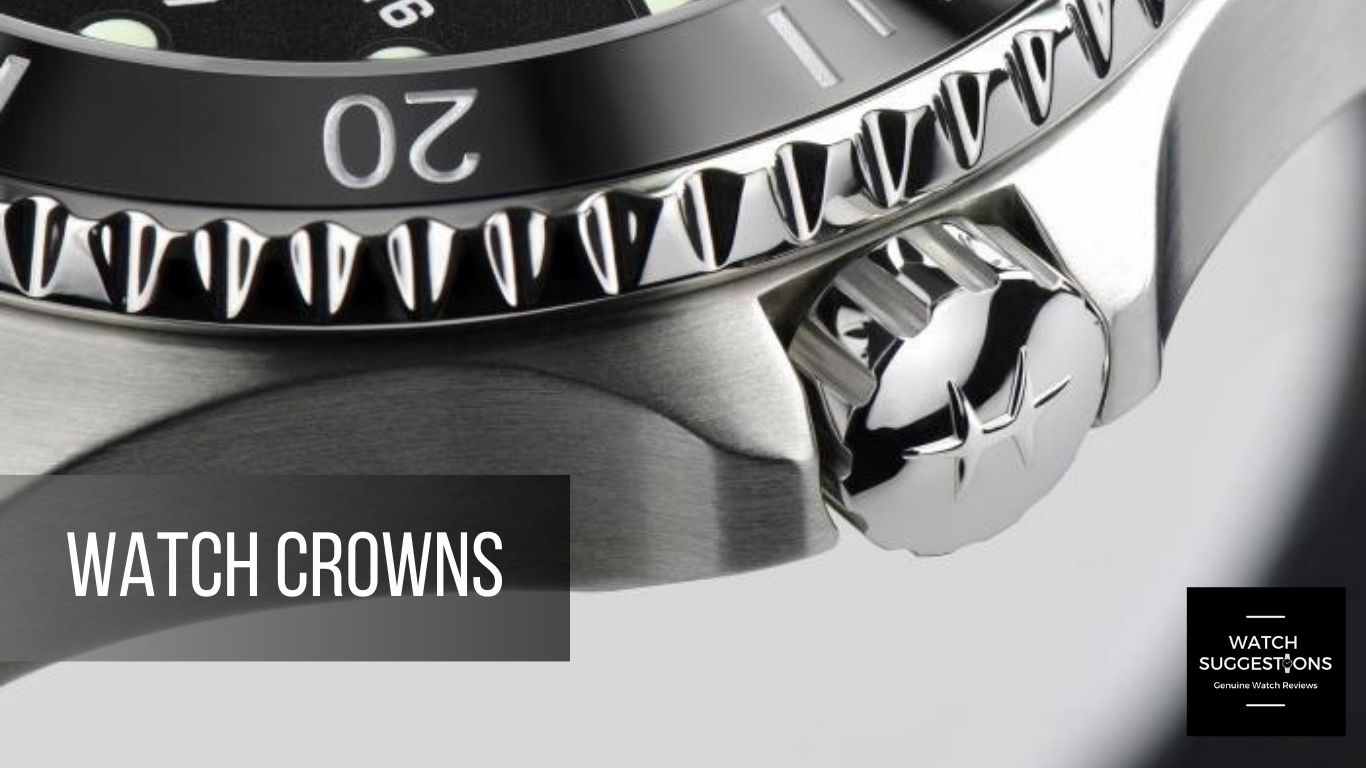
The watch crown is the small ribbed knob, typically located at the 3 o’clock position on a watch case. It is also known as the winding crown.
Despite its size, the crown connects directly to the internal movement of the watch, making it one of the most essential components. It is used to wind the watch, set the time and date, and control various functions depending on the watch type.
What Does a Watch Crown Do?
The crown is not just a simple knob; it acts as the control centre of your watch.
1. Winding the mainspring
For mechanical and automatic watches, the crown is used to wind the mainspring, which stores energy and powers the watch.
2. Setting the time and date
By pulling the crown into different positions, you can adjust the time and, in many watches, the date.
3. Controlling complications
On advanced watches, the crown is used to manage features like GMT, moonphase, or world time.
4. Supporting water resistance
In watches with a screw-down crown, it helps seal the case and protect the movement from moisture.
Watch Crown Positions Explained
Understanding crown positions is critical if you actually want to use your watch correctly.
Position 0 — Normal / Screwed-In
- Crown is fully pushed in (or screwed down)
- Ensures water resistance
- Watch runs normally
Position 1 — Winding Position
- Used to manually wind the watch
- Typically, 20–40 turns are enough for most watches
Position 2 — Date Setting
- Allows you to change the date
- Important: Avoid adjusting the date between 9 PM and 3 AM (can damage the movement)
Position 3 — Time Setting (Hacking)
- Stops the second hand (in many watches)
- Allows precise time setting
Not all watches have all positions; this depends on the movement and complexity.
For more insights on watch anatomy and history, check out our take on Crown and Caliber, a deep dive into how these two elements define craftsmanship.
Can You Overwind a Watch?
This is a common myth. Most modern automatic watches are equipped with a mechanism that prevents overwinding. So, once the mainspring reaches its maximum tension, the winding system disengages.
On vintage manual watches, yes, overwinding was a real risk. But with today’s engineering, overwinding is no longer a serious concern for most collectors.
History of the Watch Crown


Before the 1830s, watches were wound using a separate key, similar to clocks. This changed when Antoine Louis Breguet introduced the keyless winding system, which later evolved into what we now call the crown. At that time, it was simply called a knob.
Although small, this innovation transformed watch usability and remains a fundamental part of modern watch design.
The watch crown plays a central role in both function and usability. On quartz watches, it is mainly used for setting the time. But on mechanical watches, it is the primary interface between the wearer and the movement.
Why Is the Crown of the Watch Important?
The watch’s crown and head position are both referred to by their name. This shows how significant its function is.
People have asked me the bizarre question, “Can a watch work without a crown?” Most likely, the answer depends on the watch’s condition. Particularly about the kind of watch movement.
You might only use it to set the time on a basic quartz movement, which doesn’t rely on manual winding. But on a manual mechanical watch, the crown is your only access to power.
Besides adjusting the time and performing a hacking function (which stops the second hand for accurate setting), watchmakers continue to develop new inventions and complications, all configured via the crown.
This is reflected in the evolution of their design and placement. A crown on a mechanical watch lets the wearer wind the mainspring of the watch to power the internal movement.
On watches with more complex functions, such as world-timer, GMT, and moonphase, a crown is used to configure every detail.
In diving watches, a screw-down crown helps form a water-resistant seal that protects the internal movement.
Crown Position and Wearability
Crown placement isn’t random. Most watches place the crown at 3 o’clock, but some, especially for left-handed wearers, are positioned at 9 o’clock or even 4 o’clock to enhance comfort.
Designers also add crown guards to prevent accidental impact. These small side flanges on the case protect the crown from damage, especially useful in tool and diving watches.
Types of Watch Crown
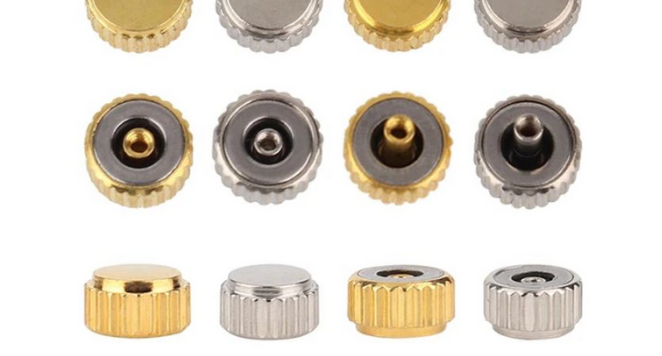

Different watches use different crown designs based on functionality, durability, and style.
1. Conical Crowns
The top conical crown is typically rounded and ribbed, and the sides are tapered. Its design is rooted in early aviation, easy to grip, even with gloves on.
2. Cabochon-Studded Crowns
Cabochon crowns have a domed gemstone embedded on top. urely ornamental, but utterly luxurious. A homage to attention to detail.
3. Screw-Down Crown / Inset Crown
Designers created the inset crown to prevent it from catching on a sleeve or other external material. Designers keep it subtle by recessing it into the watch face or placing it between crown protectors. Additionally, these crowns help to create a watertight seal on watches that are more water-resistant.
4. Onion Crowns
You guessed it, shaped like an onion. A throwback to pocket watches and early aviation, these crowns are large, bulbous, and bold.
5. Crowns with Buttons (Chronograph Crowns)
Used in chronographs, these crowns have an integrated push button; no extra stopwatch buttons are needed. The integrated button makes it simple for the wearer to start, stop, and reset the chronograph.
6. Straight Crowns
The straight crown is the most famous. Because of its effortlessness and simplicity. The majority of collector luxury watches feature this style. It is regarded as a classic.
But, crowns are more than a decorative part. Their boasts reflect the integrity and utility of their designs. You use the crown to wind both mechanical and automatic watches. In most cases, it is used to set the extra watch components. Like the lunar calendar, as well as the central clock’s time.
How to Wind Your Watch?
To wind a mechanical watch. Simply turn the crown in a clockwise direction until you feel resistance. This obstruction winds the mainspring and provides energy to the watch’s internal movement.
Between wears, the crown of an automatic watch can be used to wind the watch. Just by turning the crown in its first position (counterclockwise to pull it out, then wind clockwise), around 20–40 turns is typical.
After winding, push and turn the crown back into the case to secure it against the case and maintain the seal.
Need a full step-by-step visual? Here’s a complete guide on how to wind an automatic watch the right way — without damaging your movement.
Conclusion


The watch crown plays a crucial role, especially in the operation and functionality of a timepiece. It is a small but important component of a watch that allows the wearer to adjust the time and date, wind the watch, and even activate high-level complications. Without the watch crown, your watch would be incomplete, and in many cases, unusable.
So next time you admire a watch, don’t just look at the dial or case. Look at the crown. That little detail holds more history, power, and personality than you might think.
And if you want to keep your automatic watch powered even when not wearing it, consider using a watch winder for automatic watches — especially for collectors with multiple timepieces.
FAQs
What does a watch crown do?
The watch crown acts as the control centre of a watch. It is used to wind the mainspring in mechanical watches, set the time and date, and adjust additional features like GMT or moonphase in more complex timepieces. In watches with a screw-down crown, it also helps maintain water resistance by sealing the case.
Which way should a watch crown face?
Most watches are designed with the crown positioned at the 3 o’clock side of the case, facing outward for easy access. However, some watches place the crown at 4 o’clock for better comfort or at 9 o’clock for left-handed wearers. The direction doesn’t affect performance; it’s mainly about ergonomics and design.
Can you replace a watch crown?
Yes, a watch crown can be replaced. If it becomes damaged, worn out, or detached, a watchmaker can install a new crown and, if needed, replace the stem or internal components. It’s important to use a compatible crown to maintain proper function and water resistance.
Can a watch work without the crown?
In most cases, no. A watch cannot function properly without a crown. Mechanical watches rely on it for winding and setting the time, while even quartz watches need it for adjustments. Without a crown, the internal movement is exposed, increasing the risk of dust, moisture, and damage.
My watch crown fell off. What should I do next?
If your watch crown falls off, stop using the watch immediately. Avoid trying to fix it yourself, as this can cause further damage. Keep the watch in a safe, dry place and take it to a professional watchmaker. The issue may involve the stem or internal mechanism, and proper repair is necessary to restore function and prevent moisture from entering the case.